



Erratum in
Abstract
Background: Cancer is a major cause of death in children worldwide, and the recorded incidence tends to increase with time. Internationally comparable data on childhood cancer incidence in the past two decades are scarce. This study aimed to provide internationally comparable local data on the incidence of childhood cancer to promote research of causes and implementation of childhood cancer control.
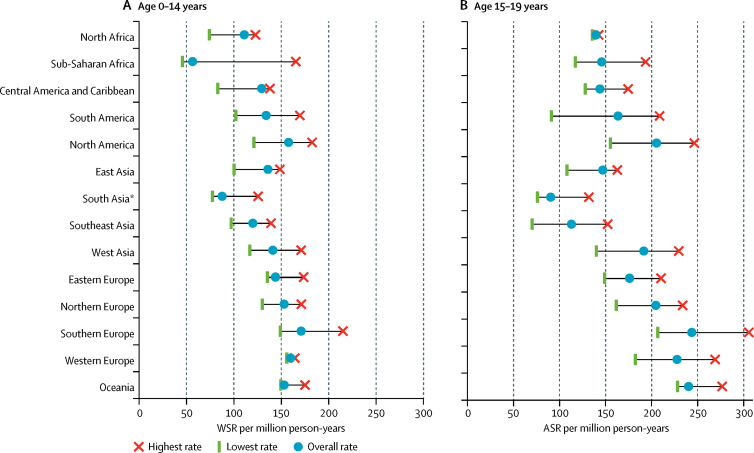
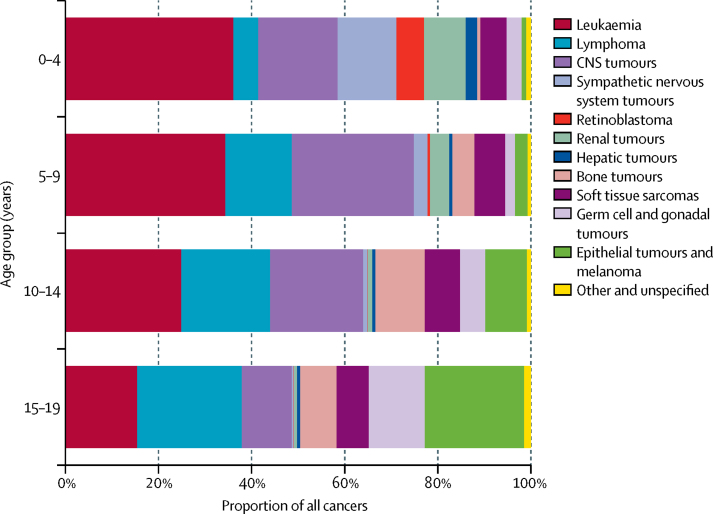
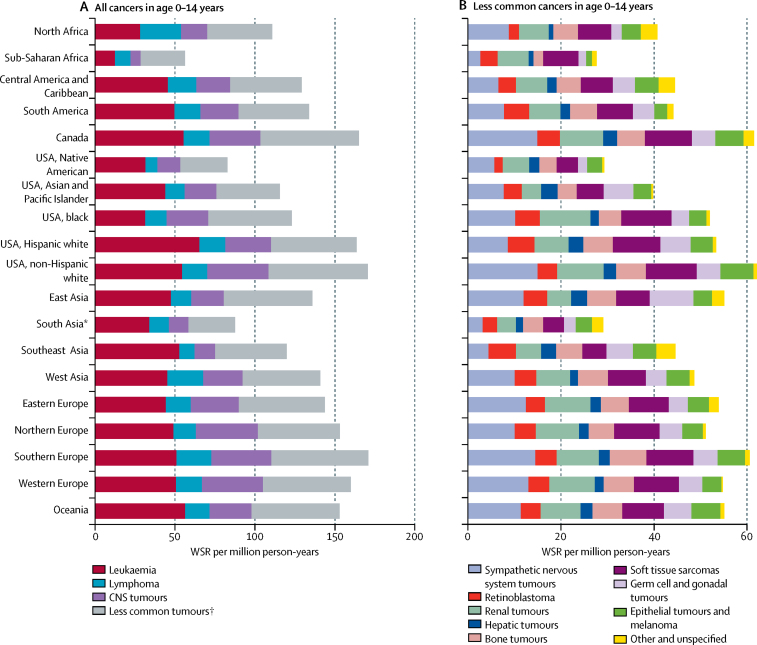
Methods: This population-based registry study, devised by the International Agency for Research on Cancer in collaboration with the International Association of Cancer Registries, collected data on all malignancies and non-malignant neoplasms of the CNS diagnosed before age 20 years in populations covered by high-quality cancer registries with complete data for 2001-10. Incidence rates per million person-years for the 0-14 years and 0-19 years age groups were age-adjusted using the world standard population to provide age-standardised incidence rates (WSRs), using the age-specific incidence rates (ASR) for individual age groups (0-4 years, 5-9 years, 10-14 years, and 15-19 years). All rates were reported for 19 geographical areas or ethnicities by sex, age group, and cancer type. The regional WSRs for children aged 0-14 years were compared with comparable data obtained in the 1980s.
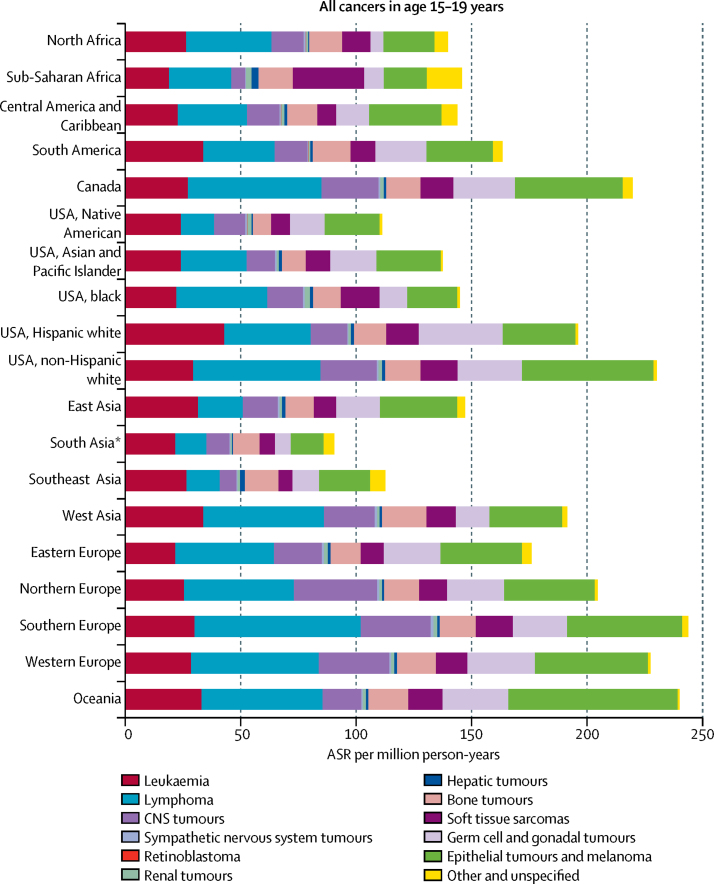
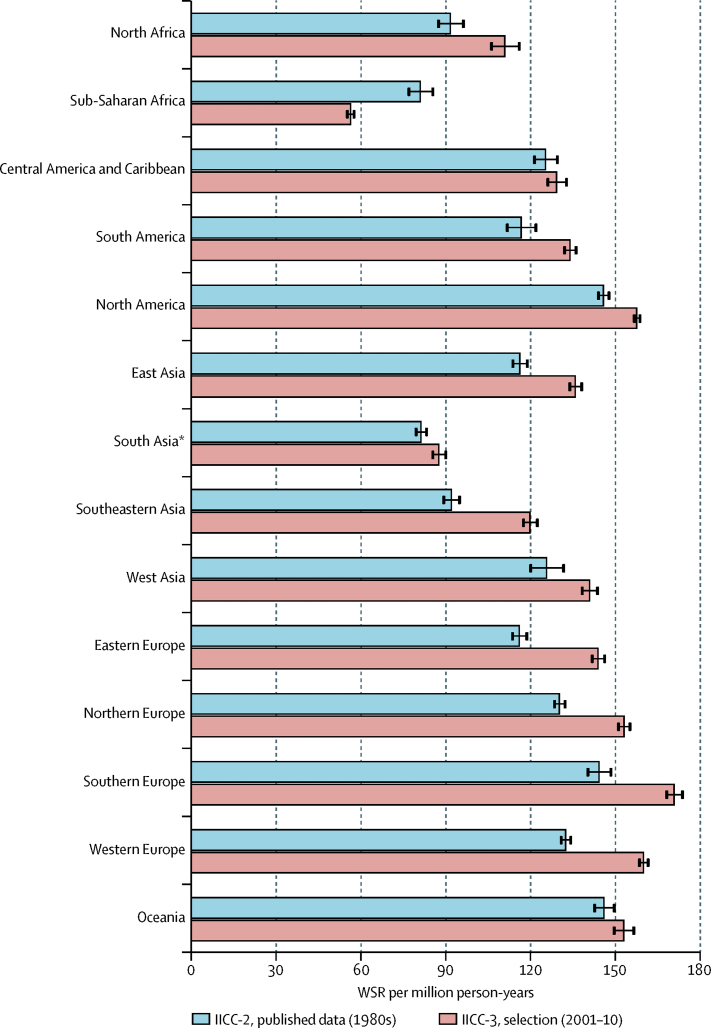
Findings: Of 532 invited cancer registries, 153 registries from 62 countries, departments, and territories met quality standards, and contributed data for the entire decade of 2001-10. 385 509 incident cases in children aged 0-19 years occurring in 2·64 billion person-years were included. The overall WSR was 140·6 per million person-years in children aged 0-14 years (based on 284 649 cases), and the most common cancers were leukaemia (WSR 46·4), followed by CNS tumours (WSR 28·2), and lymphomas (WSR 15·2). In children aged 15-19 years (based on 100 860 cases), the ASR was 185·3 per million person-years, the most common being lymphomas (ASR 41·8) and the group of epithelial tumours and melanoma (ASR 39·5). Incidence varied considerably between and within the described regions, and by cancer type, sex, age, and racial and ethnic group. Since the 1980s, the global WSR of registered cancers in children aged 0-14 years has increased from 124·0 (95% CI 123·3-124·7) to 140·6 (140·1-141·1) per million person-years.
Interpretation: This unique global source of childhood cancer incidence will be used for aetiological research and to inform public health policy, potentially contributing towards attaining several targets of the Sustainable Development Goals. The observed geographical, racial and ethnic, age, sex, and temporal variations require constant monitoring and research.
Funding: International Agency for Research on Cancer and the Union for International Cancer Control.
Copyright © 2017 World Health Organization; licensee Elsevier. This is an Open Access article published under the CC BY-NC-ND 3.0 IGO license which permits users to download and share the article for non-commercial purposes, so long as the article is reproduced in the whole without changes, and provided the original source is properly cited. This article shall not be used or reproduced in association with the promotion of commercial products, services or any entity. There should be no suggestion that WHO endorses any specific organisation, products, or services. The use of the WHO logo is not permitted. This notice should be preserved along with the article’s original URL.
Figures
Comment in
-
Do big numbers assure high-quality of data?Lancet Haematol. 2017 Jul;4(7):e309. doi: 10.1016/S2352-3026(17)30107-2.PMID: 28668190 No abstract available.
Similar articles
-
Italian cancer figures, report 2012: Cancer in children and adolescents.Epidemiol Prev. 2013 Jan-Feb;37(1 Suppl 1):1-225.PMID: 23585445 English, Italian.
-
Changing geographical patterns and trends in cancer incidence in children and adolescents in Europe, 1991-2010 (Automated Childhood Cancer Information System): a population-based study.Lancet Oncol. 2018 Sep;19(9):1159-1169. doi: 10.1016/S1470-2045(18)30423-6. Epub 2018 Aug 8.PMID: 30098952 Free PMC article.
-
Italian cancer figures–Report 2015: The burden of rare cancers in Italy.Epidemiol Prev. 2016 Jan-Feb;40(1 Suppl 2):1-120. doi: 10.19191/EP16.1S2.P001.035.PMID: 26951748
-
Worldwide variations in colorectal cancer.CA Cancer J Clin. 2009 Nov-Dec;59(6):366-78. doi: 10.3322/caac.20038.PMID: 19897840 Review.
-
Evaluation of data quality at the Hungarian National Cancer Registry, 2000-2019.Cancer Epidemiol. 2023 Feb;82:102306. doi: 10.1016/j.canep.2022.102306. Epub 2022 Dec 13.PMID: 36521336 Review.
Cited by
-
Depressive and Anxiety Disorders of Parents of Children with Cancer.J Clin Med. 2022 Sep 26;11(19):5670. doi: 10.3390/jcm11195670.PMID: 36233541 Free PMC article.
-
Inequities in childhood cancer research: A scoping review.EJC Paediatr Oncol. 2024 Dec;4:100171. doi: 10.1016/j.ejcped.2024.100171. Epub 2024 Jun 18.PMID: 38948690 Free PMC article.
-
Pediatric and Adolescent Oncofertility in Male Patients-From Alpha to Omega.Genes (Basel). 2021 May 8;12(5):701. doi: 10.3390/genes12050701.PMID: 34066795 Free PMC article. Review.
-
Chemotherapy induces plasmatic antioxidant changes in pediatric patients with acute lymphoid leukemia B that correlate to disease prognosis.Curr Res Immunol. 2022 Sep 28;3:228-233. doi: 10.1016/j.crimmu.2022.09.001. eCollection 2022.PMID: 36189176 Free PMC article.
-
Resources for the practice of pediatric neuro-oncology in Mexico: a cross-sectional evaluation.Front Oncol. 2024 Jun 21;14:1330705. doi: 10.3389/fonc.2024.1330705. eCollection 2024.PMID: 38974245 Free PMC article.
References
- Parkin DM, Stiller CA, Draper GJ, Bieber CA, Terracini B, Young JL. International incidence of childhood cancer. International Agency for Research on Cancer; Lyon: 1988. – PubMed
- Parkin DM, Kramarova E, Draper GJ. International incidence of childhood cancer, volume 2. International Agency for Research on Cancer; Lyon: 1998.
- Ries LG, Smith MA, Gurney J. Cancer incidence and survival among children and adolescents: United States SEER Program 1975–1995. National Cancer Institute, SEER Program; Bethesda, MD: 1999. p. 179.
- Steliarova-Foucher E, Kaatsch P, Lacour B. Quality, comparability and methods of analysis of data on childhood cancer in Europe (1978–1997): report from the Automated Childhood Cancer Information System project. Eur J Cancer. 2006;42:1915–1951. – PubMed
- Fritz A, Percy C, Jack A. International classification of diseases for oncology (ICD-O) 3rd edn. World Health Organization; Geneva: 2000.
- Steliarova-Foucher E, Stiller C, Lacour B, Kaatsch P. International classification of childhood cancer, third edition. Cancer. 2005;103:1457–1467. – PubMed
- Segi M, Fujisaku S, Kurihara M, Narai Y, Sasajima K. The age-adjusted death rates for malignant neoplasms in some selected sites in 23 countries in 1954–1955 and their geographical correlation. Tohoku J Exp Med. 1960;72:91–103. – PubMed
- UN Department of Economic and Social Affairs Statistics division: methodology. Standard country or area codes for statistical use (M49) https://unstats.un.org/unsd/methodology/m49/ (accessed Oct 28, 2016).
- UN Department of Economic and Social Affairs Population division; world population prospects 2015. https://esa.un.org/unpd/wpp/ (accessed Jan 19, 2017).
- Parkin DM, Stiller CA, Draper GJ, Bieber CA. The international incidence of childhood cancer. Int J Cancer. 1988;42:511–520. – PubMed
- Ducore JM, Parikh-Patel A, Gold EB. Cancer occurrence in southeast Asian children in California. J Pediatr Hematol Oncol. 2004;26:613–618. – PubMed
- Dorak MT, Karpuzoglu E. Gender differences in cancer susceptibility: an inadequately addressed issue. Front Genet. 2012;3:268. – PMC – PubMed
- Magrath I, Steliarova-Foucher E, Epelman S. Paediatric cancer in low-income and middle-income countries. Lancet Oncol. 2013;14:e104–e116. – PubMed
- Ospina-Romero M, Portilla CA, Bravo LE, Ramirez O. Caregivers’ self-reported absence of social support networks is related to treatment abandonment in children with cancer. Pediatr Blood Cancer. 2016;63:825–831. – PubMed
- Steliarova-Foucher E, Stiller C, Colombet M, Kaatsch P, Zanetti R, Peris-Bonet R. Registration of childhood cancer: moving towards pan-European coverage? Eur J Cancer. 2015;51:1064–1079. – PubMed
- Mahoney MC, Va P, Stevens A, Kahn AR, Michalek AM. Fifty years of cancer in an American Indian population. Cancer. 2009;115:419–427. – PubMed
- Welch HG, Black WC. Overdiagnosis in cancer. J Natl Cancer Inst. 2010;102:605–613. – PubMed
- Stefan DC, Stones DK, Wainwright RD. Childhood cancer incidence in South Africa, 1987–2007. S Afr Med J. 2015;105:939–947. – PubMed
- Mutyaba I, Phipps W, Krantz EM. A population-level evaluation of the effect of antiretroviral therapy on cancer incidence in Kyadondo County, Uganda, 1999–2008. J Acquir Immune Defic Syndr. 2015;69:481–486. – PMC – PubMed
- Wabinga HR, Nambooze S, Amulen PM, Okello C, Mbus L, Parkin DM. Trends in the incidence of cancer in Kampala, Uganda 1991–2010. Int J Cancer. 2014;135:432–439. – PubMed
- Togo B, Traore F, Togo AP. Epidemiology and prognosis of childhood cancers at Gabriel-Toure Teaching Hospital (Bamako, Mali) Med Sante Trop. 2014;24:68–72. (in French). – PubMed
- Macartney S, Bishaw A, Fontenot K. Poverty rates for selected detailed race and Hispanic groups by state and place: 2007–2011. United Stated Census Bureau; Washington, DC: 2013.
- Walsh KM, Chokkalingam AP, Hsu LI. Associations between genome-wide Native American ancestry, known risk alleles and B-cell ALL risk in Hispanic children. Leukemia. 2013;27:2416–2419. – PMC – PubMed
- Gupta A. Pesticide use in south and south-east Asia: environmental public health and legal concerns. Am J Environ Sci. 2012;8:152.
- Ward MH, Colt JS, Metayer C. Residential exposure to polychlorinated biphenyls and organochlorine pesticides and risk of childhood leukemia. Environ Health Perspect. 2009;117:1007–1013. – PMC – PubMed
- Hernandez AF, Menendez P. linking pesticide exposure with pediatric leukemia: potential underlying mechanisms. Int J Mol Sci. 2016;17:461. – PMC – PubMed
- Horesh N, Horowitz NA. Does gender matter in non-Hodgkin lymphoma? Differences in epidemiology, clinical behavior, and therapy. Rambam Maimonides Med J. 2014;5:e0038. – PMC – PubMed
- Stiller CA, Parkin DM. International variations in the incidence of childhood lymphomas. Paediatr Perinat Epidemiol. 1990;4:303–324. – PubMed
- Levine AM. AIDS-related malignancies: the emerging epidemic. J Natl Cancer Inst. 1993;85:1382–1397. – PubMed
- van den Bosch CA. Is endemic Burkitt’s lymphoma an alliance between three infections and a tumour promoter? Lancet Oncol. 2004;5:738–746. – PubMed
- Mutalima N, Molyneux E, Jaffe H. Associations between Burkitt lymphoma among children in Malawi and infection with HIV, EBV and malaria: results from a case-control study. PLoS One. 2008;3:e2505. – PMC – PubMed
- Koh YW, Kang HJ, Yoon DH. Changing trend of Epstein-Barr virus association in Hodgkin lymphoma in the Republic of Korea. Ann Hematol. 2013;92:1653–1660. – PubMed
- Hjalgrim H. On the aetiology of Hodgkin lymphoma. Dan Med J. 2012;59:B4485. – PubMed
- Amayiri N, Bouffet E. Pediatric neuro-oncology. In: Stefan DC, Rodriguez-Galindo C, editors. Pediatric neuro-oncology in countries with limited resources: a practical manual. Springer Science & Business Media; New York: 2014. pp. 365–376.
- Hadley LG, Rouma BS, Saad-Eldin Y. Challenge of pediatric oncology in Africa. Semin Pediatr Surg. 2012;21:136–141. – PubMed
- Reutfors J, Kramarova E, Weiderpass E, Monge P, Wesseling C, Ahlbom A. Central nervous system tumours in children in Costa Rica, 1981–96. Paediatr Perinat Epidemiol. 2002;16:219–225. – PubMed

