



Javier David Benitez Fuentes 1 2 3, Eileen Morgan 1, Alicia de Luna Aguilar 2 3, Allini Mafra 1, Richa Shah 1, Francesco Giusti 1 4, Jérôme Vignat 1, Ariana Znaor 1, Carina Musetti 5, Cheng-Har Yip 6 7, Liesbet Van Eycken 1 4, Elima Jedy-Agba 8, Marion Piñeros 1, Isabelle Soerjomataram 1
Affiliations Expand
PMID: 37943547 PMCID: PMC10636649 DOI: 10.1001/jamaoncol.2023.4837
Abstract
Importance: Stage at diagnosis is a key prognostic factor for cancer survival.
Objective: To assess the global distribution of breast cancer stage by country, age group, calendar period, and socioeconomic status using population-based data.
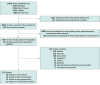
Data sources: A systematic search of MEDLINE and Web of Science databases and registry websites and gray literature was conducted for articles or reports published between January 1, 2000, and June 20, 2022.
Study selection: Reports on stage at diagnosis for individuals with primary breast cancer (C50) from a population-based cancer registry were included.
Data extraction and synthesis: Study characteristics and results of eligible studies were independently extracted by 2 pairs of reviewers (J.D.B.F., A.D.A., A.M., R.S., and F.G.). Stage-specific proportions were extracted and cancer registry data quality and risk of bias were assessed. National pooled estimates were calculated for subnational or annual data sets using a hierarchical rule of the most relevant and high-quality data to avoid duplicates.
Main outcomes and measures: The proportion of women with breast cancer by (TNM Classification of Malignant Tumors or the Surveillance, Epidemiology, and End Results Program [SEER]) stage group.
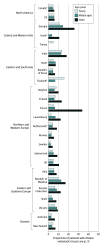
Results: Data were available for 2.4 million women with breast cancer from 81 countries. Globally, the proportion of cases with distant metastatic breast cancer at diagnosis was high in sub-Saharan Africa, ranging from 5.6% to 30.6% and low in North America ranging from 0.0% to 6.0%. The proportion of patients diagnosed with distant metastatic disease decreased over the past 2 decades from around 3.8% to 35.8% (early 2000s) to 3.2% to 11.6% (2015 onwards), yet stabilization or slight increases were also observed. Older age and lower socioeconomic status had the largest proportion of cases diagnosed with distant metastatic stage ranging from 2.0% to 15.7% among the younger to 4.1% to 33.9% among the oldest age group, and from 1.7% to 8.3% in the least disadvantaged groups to 2.8% to 11.4% in the most disadvantaged groups.
Conclusions and relevance: Effective policy and interventions have resulted in decreased proportions of women diagnosed with metastatic breast cancer at diagnosis in high-income countries, yet inequality persists, which needs to be addressed through increased awareness of breast cancer symptoms and early detection. Improving global coverage and quality of population-based cancer registries, including the collection of standardized stage data, is key to monitoring progress.
PubMed Disclaimer
Conflict of interest statement
Conflict of Interest Disclosures: None reported.
Figures

Similar articles
-
Folic acid supplementation and malaria susceptibility and severity among people taking antifolate antimalarial drugs in endemic areas.Cochrane Database Syst Rev. 2022 Feb 1;2(2022):CD014217. doi: 10.1002/14651858.CD014217.PMID: 36321557 Free PMC article.
-
Beyond the black stump: rapid reviews of health research issues affecting regional, rural and remote Australia.Med J Aust. 2020 Dec;213 Suppl 11:S3-S32.e1. doi: 10.5694/mja2.50881.PMID: 33314144
-
[SENTIERI – Epidemiological Study of Residents in National Priority Contaminated Sites. Sixth Report].Epidemiol Prev. 2023 Jan-Apr;47(1-2 Suppl 1):1-286. doi: 10.19191/EP23.1-2-S1.003.PMID: 36825373 Italian.
-
Screening for Skin Cancer in Adults: An Updated Systematic Evidence Review for the U.S. Preventive Services Task Force [Internet].Rockville (MD): Agency for Healthcare Research and Quality (US); 2016 Jul. Report No.: 14-05210-EF-1.PMID: 27583318 Free Books & Documents. Review.
-
Stage at diagnosis of breast cancer in sub-Saharan Africa: a systematic review and meta-analysis.Lancet Glob Health. 2016 Dec;4(12):e923-e935. doi: 10.1016/S2214-109X(16)30259-5.PMID: 27855871 Free PMC article. Review.
Cited by
-
Omics Studies of Tumor Cells under Microgravity Conditions.Int J Mol Sci. 2024 Jan 11;25(2):926. doi: 10.3390/ijms25020926.PMID: 38255998 Free PMC article. Review.
-
Diagnosis and treatment status of inoperable locally advanced breast cancer and the application value of inorganic nanomaterials.J Nanobiotechnology. 2024 Jun 25;22(1):366. doi: 10.1186/s12951-024-02644-9.PMID: 38918821 Free PMC article. Review.
-
Global, regional, and national burden of female cancers in women of child-bearing age, 1990-2021: analysis of data from the global burden of disease study 2021.EClinicalMedicine. 2024 Jul 2;74:102713. doi: 10.1016/j.eclinm.2024.102713. eCollection 2024 Aug.PMID: 39050105 Free PMC article.
-
Current biological implications and clinical relevance of metastatic circulating tumor cells.Clin Exp Med. 2024 Nov 15;25(1):7. doi: 10.1007/s10238-024-01518-6.PMID: 39546080 Free PMC article. Review.
-
Cell Death: Mechanisms and Potential Targets in Breast Cancer Therapy.Int J Mol Sci. 2024 Sep 7;25(17):9703. doi: 10.3390/ijms25179703.PMID: 39273650 Free PMC article. Review.
References
- Ferlay J, Ervik M, Lam F, et al. . Global Cancer Observatory: Cancer Today. International Agency for Research on Cancer; 2020. Accessed March 31, 2022. https://gco.iarc.fr/today
- Sung H, Ferlay J, Siegel RL, et al. . Global cancer statistics 2020: GLOBOCAN estimates of incidence and mortality worldwide for 36 cancers in 185 countries. CA Cancer J Clin. 2021;71(3):209-249. doi:10.3322/caac.21660 – DOI – PubMed
- Arnold M, Morgan E, Rumgay H, et al. . Current and future burden of breast cancer: global statistics for 2020 and 2040. Breast. 2022;66:15-23. doi:10.1016/j.breast.2022.08.010 – DOI – PMC – PubMed
- Allemani C, Matsuda T, Di Carlo V, et al. ; CONCORD Working Group . Global surveillance of trends in cancer survival 2000-14 (CONCORD-3): analysis of individual records for 37 513 025 patients diagnosed with one of 18 cancers from 322 population-based registries in 71 countries. Lancet. 2018;391(10125):1023-1075. doi:10.1016/S0140-6736(17)33326-3 – DOI – PMC – PubMed
- Piñeros M, Parkin DM, Ward K, et al. . Essential TNM: a registry tool to reduce gaps in cancer staging information. Lancet Oncol. 2019;20(2):e103-e111. doi:10.1016/S1470-2045(18)30897-0 – DOI – PubMed

