



Harriet Rumgay 1, Melina Arnold 2, Jacques Ferlay 2, Olufunmilayo Lesi 3, Citadel J Cabasag 2, Jérôme Vignat 2, Mathieu Laversanne 2, Katherine A McGlynn 4, Isabelle Soerjomataram 2
Affiliations Expand
PMID: 36208844 PMCID: PMC9670241 DOI: 10.1016/j.jhep.2022.08.021
Abstract
Background & aims: The burden of liver cancer varies across the world. Herein, we present updated estimates of the current global burden of liver cancer (incidence and mortality) and provide predictions of the number of cases/deaths to 2040.
Methods: We extracted data on primary liver cancer cases and deaths from the GLOBOCAN 2020 database, which includes 185 countries. Age-standardised incidence and mortality rates (ASRs) per 100,000 person-years were calculated. Cases and deaths up to the year 2040 were predicted based on incidence and mortality rates for 2020 and global demographic projections to 2040.
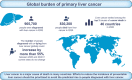
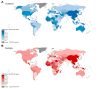
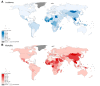
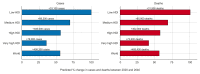
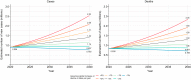
Results: In 2020, an estimated 905,700 people were diagnosed with, and 830,200 people died from, liver cancer globally. Global ASRs for liver cancer were 9.5 and 8.7 for new cases and deaths, respectively, per 100,000 people and were highest in Eastern Asia (17.8 new cases, 16.1 deaths), Northern Africa (15.2 new cases, 14.5 deaths), and South-Eastern Asia (13.7 new cases, 13.2 deaths). Liver cancer was among the top three causes of cancer death in 46 countries and was among the top five causes of cancer death in 90 countries. ASRs of both incidence and mortality were higher among males than females in all world regions (male:female ASR ratio ranged between 1.2-3.6). The number of new cases of liver cancer per year is predicted to increase by 55.0% between 2020 and 2040, with a possible 1.4 million people diagnosed in 2040. A predicted 1.3 million people could die from liver cancer in 2040 (56.4% more than in 2020).
Conclusions: Liver cancer is a major cause of death in many countries, and the number of people diagnosed with liver cancer is predicted to rise. Efforts to reduce the incidence of preventable liver cancer should be prioritised.
Lay summary: The burden of liver cancer varies across the world. Liver cancer was among the top three causes of cancer death in 46 countries and was among the top five causes of cancer death in 90 countries worldwide. We predict the number of cases and deaths will rise over the next 20 years as the world population grows. Primary liver cancer due to some causes is preventable if control efforts are prioritised and the predicted rise in cases may increase the need for resources to manage care of patients with liver cancer.
Keywords: Hepatocellular carcinoma; cancer registries; epidemiology; intrahepatic cholangiocarcinoma.
Copyright © 2022. Published by Elsevier B.V.
PubMed Disclaimer
Conflict of interest statement
Conflict of interest The authors declare no conflicts of interest. Please refer to the accompanying ICMJE disclosure forms for further details.
Figures
Comment in
-
Global prediction of primary liver cancer incidences and mortality in 2040.J Hepatol. 2023 Apr;78(4):e144-e146. doi: 10.1016/j.jhep.2022.12.002. Epub 2022 Dec 10.PMID: 36513185 No abstract available.
-
Global incidence of primary liver cancer by etiology among children, adolescents, and young adults.J Hepatol. 2023 Aug;79(2):e92-e94. doi: 10.1016/j.jhep.2023.02.019. Epub 2023 Feb 24.PMID: 36841544 No abstract available.
Similar articles
-
African colorectal cancer burden in 2022 and projections to 2050.Ecancermedicalscience. 2024 Sep 26;18:1780. doi: 10.3332/ecancer.2024.1780. eCollection 2024.PMID: 39430071 Free PMC article.
-
Global, regional and national burden of primary liver cancer by subtype.Eur J Cancer. 2022 Jan;161:108-118. doi: 10.1016/j.ejca.2021.11.023. Epub 2021 Dec 20.PMID: 34942552
-
The global, regional, and national burden of stomach cancer in 195 countries, 1990-2017: a systematic analysis for the Global Burden of Disease study 2017.Lancet Gastroenterol Hepatol. 2020 Jan;5(1):42-54. doi: 10.1016/S2468-1253(19)30328-0. Epub 2019 Oct 21.PMID: 31648970 Free PMC article.
-
The Global Landscape of Esophageal Squamous Cell Carcinoma and Esophageal Adenocarcinoma Incidence and Mortality in 2020 and Projections to 2040: New Estimates From GLOBOCAN 2020.Gastroenterology. 2022 Sep;163(3):649-658.e2. doi: 10.1053/j.gastro.2022.05.054. Epub 2022 Jun 4.PMID: 35671803 Review.
-
Cancer in sub-Saharan Africa in 2020: a review of current estimates of the national burden, data gaps, and future needs.Lancet Oncol. 2022 Jun;23(6):719-728. doi: 10.1016/S1470-2045(22)00270-4. Epub 2022 May 9.PMID: 35550275 Review.
Cited by
-
Evolution of liver function during immune checkpoint inhibitor treatment for hepatocellular carcinoma.United European Gastroenterol J. 2024 Oct;12(8):1034-1043. doi: 10.1002/ueg2.12626. Epub 2024 Jul 11.PMID: 38990728 Free PMC article.
-
Outcomes of elective liver surgery worldwide: a global, prospective, multicenter, cross-sectional study.Int J Surg. 2023 Dec 1;109(12):3954-3966. doi: 10.1097/JS9.0000000000000711.PMID: 38258997 Free PMC article.
-
Targeting the SphK1/S1P/PFKFB3 axis suppresses hepatocellular carcinoma progression by disrupting glycolytic energy supply that drives tumor angiogenesis.J Transl Med. 2024 Jan 10;22(1):43. doi: 10.1186/s12967-023-04830-z.PMID: 38200582 Free PMC article.
-
Depression Exacerbates Hepatic Steatosis in C57BL/6J Mice by Activating the Hypothalamic-Pituitary-Adrenal Axis.In Vivo. 2024 Jul-Aug;38(4):1677-1689. doi: 10.21873/invivo.13618.PMID: 38936893 Free PMC article.
-
Icaritin Exerts Anti-Cancer Effects through Modulating Pyroptosis and Immune Activities in Hepatocellular Carcinoma.Biomedicines. 2024 Aug 21;12(8):1917. doi: 10.3390/biomedicines12081917.PMID: 39200381 Free PMC article.
References
- Sung H., Ferlay J., Siegel R.L., Laversanne M., Soerjomataram I., Jemal A., et al. Global cancer statistics 2020: GLOBOCAN estimates of incidence and mortality worldwide for 36 cancers in 185 countries. CA Cancer J Clin. 2021 doi: 10.3322/caac.21660. [published Online First: 2021/02/05] – DOI – PubMed
- Ferlay J., Ervik M., Lam F., Colombet M., Mery L., Piñeros M., et al. International Agency for Research on Cancer; Lyon, France: 2021. Global cancer observatory: cancer today.https://gco.iarc.fr/today/home [Available from: ]
- Arnold M., Abnet C.C., Neale R.E., Vignat J., Giovannucci E.L., McGlynn K.A., et al. Global burden of 5 major types of gastrointestinal cancer. Gastroenterology. 2020;159(1):335–349.e15. doi: 10.1053/j.gastro.2020.02.068. – DOI – PMC – PubMed
- McGlynn K.A., Petrick J.L., El-Serag H.B. Epidemiology of hepatocellular carcinoma. Hepatology. 2021;73:4–13. doi: 10.1002/hep.31288. [published Online First: 2020/11/24] – DOI – PMC – PubMed
- Chuang S.-C., Vecchia C.L., Boffetta P. Liver cancer: descriptive epidemiology and risk factors other than HBV and HCV infection. Cancer Lett. 2009;286(1):9–14. doi: 10.1016/j.canlet.2008.10.040. – DOI – PubMed

