



Melina Arnold 1, Deependra Singh 1, Mathieu Laversanne 1, Jerome Vignat 1, Salvatore Vaccarella 1, Filip Meheus 1, Anne E Cust 2 3, Esther de Vries 4, David C Whiteman 5, Freddie Bray 1
Affiliations Expand
PMID: 35353115 PMCID: PMC8968696 DOI: 10.1001/jamadermatol.2022.0160
Abstract
Importance: Despite many cases being preventable, cutaneous melanoma remains the most serious skin cancer worldwide. Understanding the scale and profile of the disease is vital to concentrate and reinforce global prevention efforts.
Objective: To examine global patterns of cutaneous melanoma in 2020 and to provide projected estimates of cases and deaths by 2040.
Design, setting, and participants: This population-based study used the GLOBOCAN 2020 database for global epidemiological assessment of new cases and deaths due to invasive melanoma.
Main outcomes and measures: Age-standardized incidence and mortality rates were calculated per 100 000 person-years by country, world region, and 4-tier level of human development. Estimated numbers of cases and deaths were calculated for the year 2040.
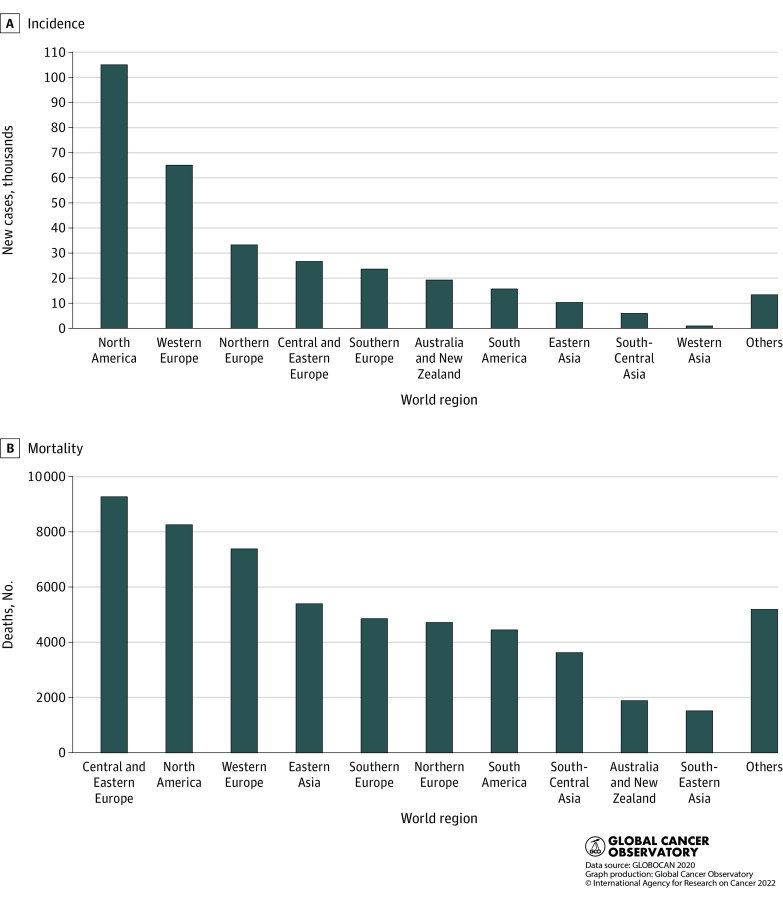
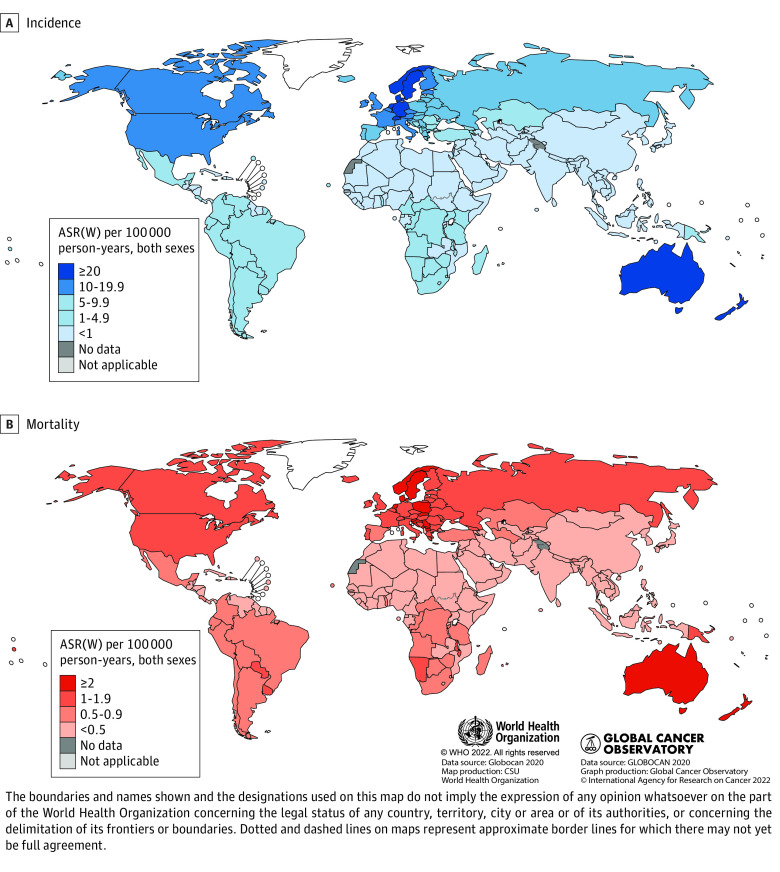
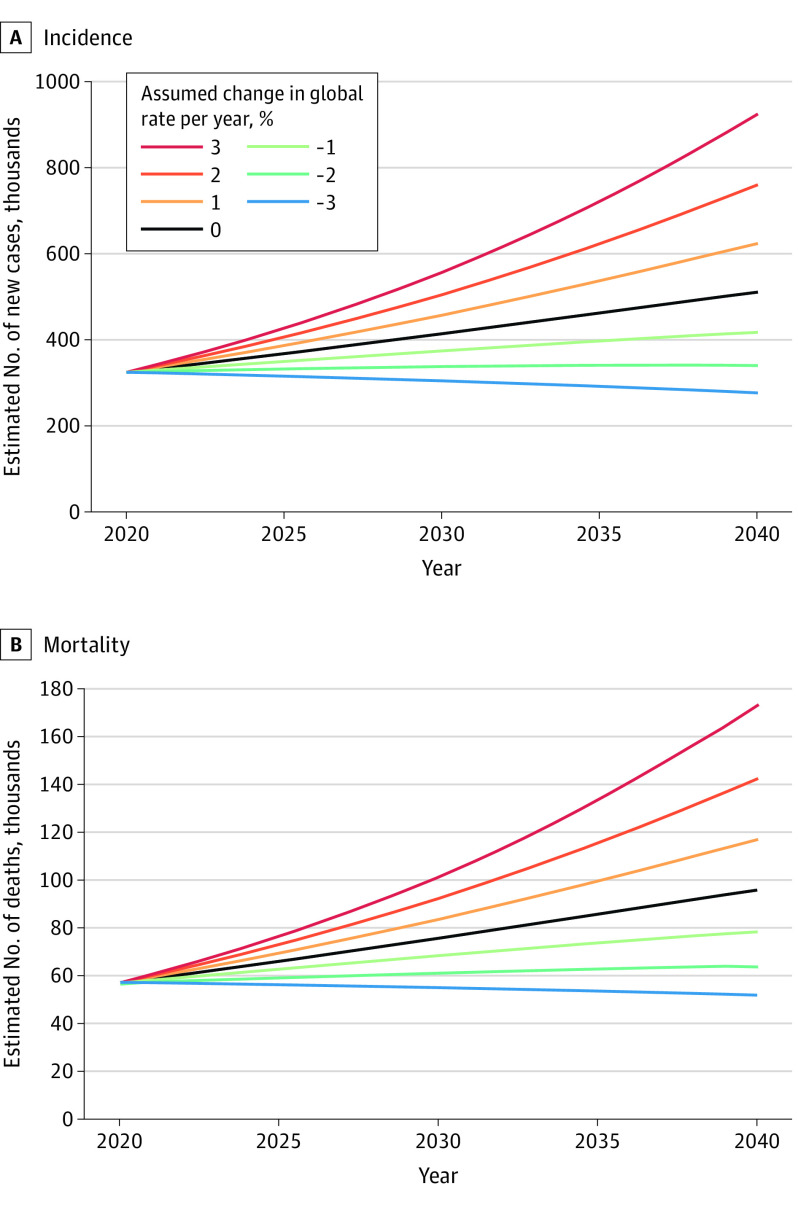
Results: A worldwide total of 325 000 new melanoma cases (174 000 males, 151 000 females) and 57 000 deaths (32 000 males, 25 000 females) was estimated for 2020. Large geographic variations existed across countries and world regions, with the highest incidence rates among males (42 per 100 000 person-years) and females (31 per 100 000 person-years) observed in Australia/New Zealand, followed by Western Europe (19 per 100 000 person-years for males and females), North America (18 per 100 000 person-years for males, 14 per 100 000 person-years for females), and Northern Europe (17 per 100 000 person-years for males, 18 per 100 000 person-years for females). Melanoma continued to be rare in most African and Asian countries, with incidence rates commonly less than 1 per 100 000 person-years. Mortality rates peaked at 5 per 100 000 person-years in New Zealand, and geographic variations were less pronounced than for incidence. Melanoma was more frequent among males than females in most world regions. If 2020 rates continue, the burden from melanoma is estimated to increase to 510 000 new cases (a roughly 50% increase) and to 96 000 deaths (a 68% increase) by 2040.
Conclusions and relevance: This epidemiological assessment suggests that melanoma remains an important challenge to cancer control and public health globally, especially in fair-skinned populations of European descent.
PubMed Disclaimer
Conflict of interest statement
Conflict of Interest Disclosures: Dr Cust reported receiving a fellowship from the Australian National Health and Medical Research Council (NHMRC) outside the submitted work. Dr de Vries reported receiving personal fees from Amgen outside the submitted work. Dr Whiteman reported receiving salary support and competitive grants from the Australian NHMRC during the conduct of the study. No other disclosures were reported.
Figures
Comment in
-
Melanoma Epidemiology-Pivoting to Low- and Middle-Income Countries.
JAMA Dermatol. 2022 May 1;158(5):489-491. doi: 10.1001/jamadermatol.2022.0162.PMID: 35353144 No abstract available.
Similar articles
-
Global burden of colorectal cancer in 2020 and 2040: incidence and mortality estimates from GLOBOCAN.
Gut. 2023 Feb;72(2):338-344. doi: 10.1136/gutjnl-2022-327736. Epub 2022 Sep 8.PMID: 36604116 -
Current and future burden of breast cancer: Global statistics for 2020 and 2040.
Breast. 2022 Dec;66:15-23. doi: 10.1016/j.breast.2022.08.010. Epub 2022 Sep 2.PMID: 36084384 Free PMC article. -
International trends in the incidence of malignant melanoma 1953-2008–are recent generations at higher or lower risk?
Int J Cancer. 2013 Jan 15;132(2):385-400. doi: 10.1002/ijc.27616. Epub 2012 May 21.PMID: 22532371 -
Epidemiology of cutaneous melanoma in Germany and worldwide.
Skin Pharmacol Appl Skin Physiol. 2001 Sep-Oct;14(5):280-90. doi: 10.1159/000056358.PMID: 11586069 Review. -
The Global Landscape of Esophageal Squamous Cell Carcinoma and Esophageal Adenocarcinoma Incidence and Mortality in 2020 and Projections to 2040: New Estimates From GLOBOCAN 2020.
Gastroenterology. 2022 Sep;163(3):649-658.e2. doi: 10.1053/j.gastro.2022.05.054. Epub 2022 Jun 4.PMID: 35671803 Review.
Cited by
-
Comprehensive analysis of aberrantly methylated differentially expressed genes and validation of CDC6 in melanoma.
J Cancer Res Clin Oncol. 2024 Jul 25;150(7):362. doi: 10.1007/s00432-024-05851-x.PMID: 39052109 Free PMC article. -
A Review of Recent Advances in Computer-Aided Detection Methods Using Hyperspectral Imaging Engineering to Detect Skin Cancer.
Cancers (Basel). 2023 Nov 29;15(23):5634. doi: 10.3390/cancers15235634.PMID: 38067338 Free PMC article. Review. -
Communicating Personal Melanoma Polygenic Risk Information: Participants’ Experiences of Genetic Counseling in a Community-Based Study.
J Pers Med. 2022 Sep 26;12(10):1581. doi: 10.3390/jpm12101581.PMID: 36294720 Free PMC article. -
Mucosal Malignant Melanoma of Head and Neck: A Case Series from a Single Institute and Review of Literature Abstract.
Indian J Otolaryngol Head Neck Surg. 2023 Dec;75(4):3415-3420. doi: 10.1007/s12070-023-04001-y. Epub 2023 Jun 24.PMID: 37974828 Free PMC article. -
Survival in patients diagnosed with melanoma in situ compared to the general population. A Swedish population-based matched cohort study.
EClinicalMedicine. 2023 Oct 24;65:102284. doi: 10.1016/j.eclinm.2023.102284. eCollection 2023 Nov.PMID: 38106551 Free PMC article.
References
- Erdmann F, Lortet-Tieulent J, Schüz J, et al. . International trends in the incidence of malignant melanoma 1953-2008—are recent generations at higher or lower risk? Int J Cancer. 2013;132(2):385-400. doi:10.1002/ijc.27616 – DOI – PubMed
- Arnold M, Holterhues C, Hollestein LM, et al. . Trends in incidence and predictions of cutaneous melanoma across Europe up to 2015. J Eur Acad Dermatol Venereol. 2014;28(9):1170-1178. doi:10.1111/jdv.12236 – DOI – PubMed
- El Ghissassi F, Baan R, Straif K, et al. ; WHO International Agency for Research on Cancer Monograph Working Group . A review of human carcinogens—part D: radiation. Lancet Oncol. 2009;10(8):751-752. doi:10.1016/S1470-2045(09)70213-X – DOI – PubMed
- International Agency for Research on Cancer. Radiation: Volume 100 D: A Review of Human Carcinogens: IARC Monographs on the Evaluation of Carcinogenic Risks to Humans. IARC Publications; 2012. – PubMed
- Arnold M, de Vries E, Whiteman DC, et al. . Global burden of cutaneous melanoma attributable to ultraviolet radiation in 2012. Int J Cancer. 2018;143(6):1305-1314. doi:10.1002/ijc.31527 – DOI – PubMed

