




Abstract
Context: Despite the improvement in renal cell carcinoma (RCC) diagnosis and management observed during the last 2 decades, RCC remains one of the most lethal urological malignancies. With the expansion of routine imaging for many disorders, an increasing number of patients who harbour RCC are identified incidentally.
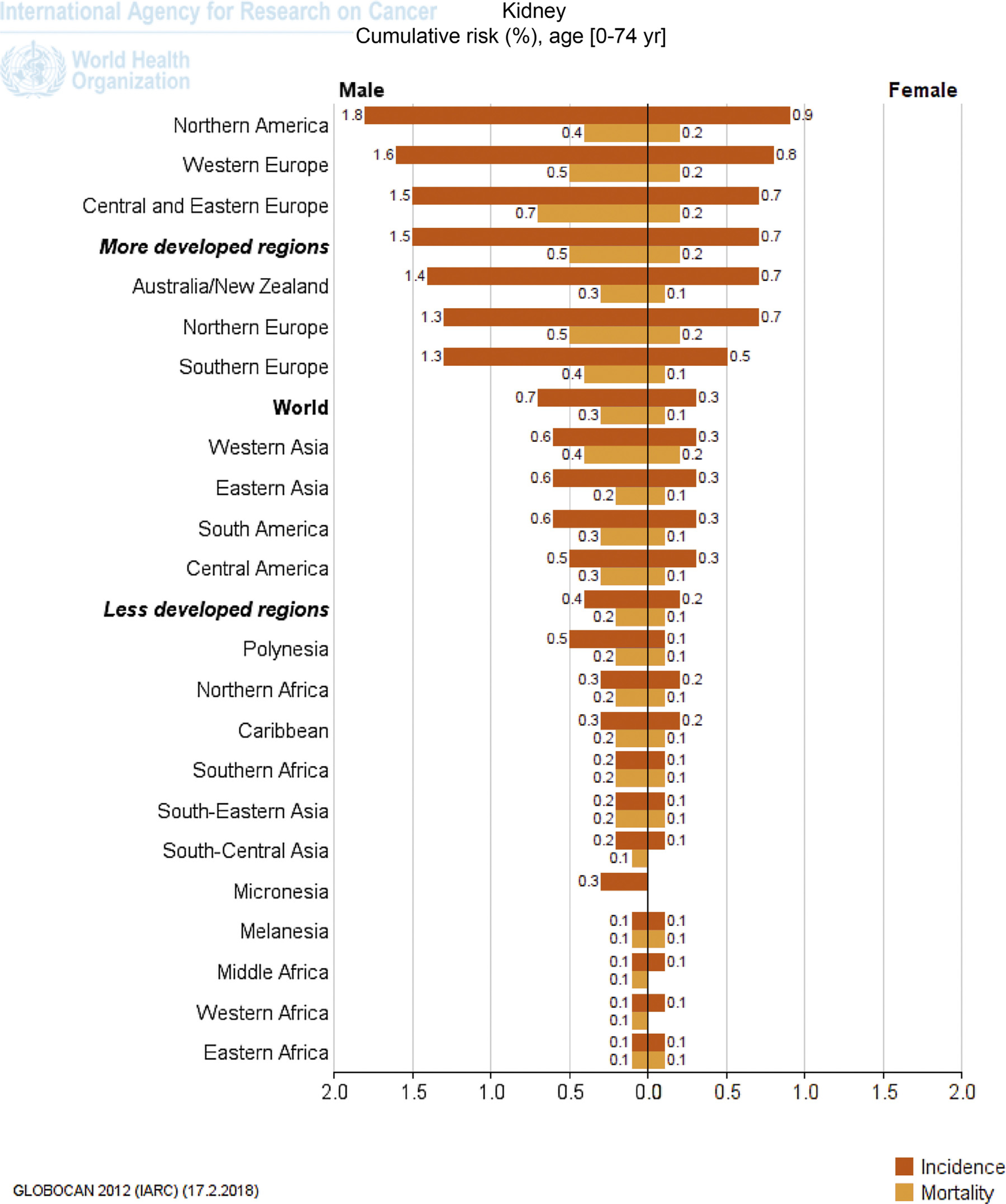
Objective: To summarise and compare RCC incidence and mortality rates, analyse the magnitude of risk factors, and interpret these epidemiological observations in the context of screening and disease management.
Evidence acquisition: The primary objective of the current review was to retrieve and describe worldwide RCC incidence/mortality rates. Secondly, a narrative literature review about the magnitude of the known risk factors was performed. Finally, data retrieved from the first two steps were elaborated to define the clinical implications for RCC screening.
Evidence synthesis: RCC incidence and mortality significantly differ among individual countries and world regions. Potential RCC risk factors include behavioural and environmental factors, comorbidities, and analgesics. Smoking, obesity, hypertension, and chronic kidney disease represent established risk factors. Other factors have been associated with an increased RCC risk, although selection biases may be present and controversial results have been reported.
Conclusions: Incidence of RCC varies worldwide. Within the several RCC risk factors identified, smoking, obesity, and hypertension are most strongly associated with RCC. In individuals at a higher risk of RCC, the cost effectiveness of a screening programme needs to be assessed on a country-specific level due to geographic heterogeneity in incidence and mortality rates, costs, and management implications. Owing to the low rates of RCC, implementation of accurate biomarkers appears to be mandatory.
Patient summary: The probability of harbouring kidney cancer is higher in developed countries and among smokers, obese individuals, and individuals with hypertension.
Keywords: Epidemiology; Incidence; Kidney cancer; Mortality; Prevalence; Renal cancer.
Copyright © 2018 European Association of Urology. Published by Elsevier B.V. All rights reserved.
Figures


Comment in
-
Lessons Learned from the Global Epidemiology of Kidney Cancer: A Refresher in Epidemiology 101.
Eur Urol. 2019 Jan;75(1):85-87. doi: 10.1016/j.eururo.2018.09.035. Epub 2018 Sep 28.PMID: 30274700 No abstract available.
Similar articles
-
Contemporary epidemiology of renal cell carcinoma: perspectives of primary prevention.
World J Urol. 2010 Jun;28(3):247-52. doi: 10.1007/s00345-010-0555-1.PMID: 20390283 Review. -
Epidemiology and risk factors for kidney cancer.
Nat Rev Urol. 2010 May;7(5):245-57. doi: 10.1038/nrurol.2010.46.PMID: 20448658 Free PMC article. Review. -
International variations and trends in renal cell carcinoma incidence and mortality.
Eur Urol. 2015 Mar;67(3):519-30. doi: 10.1016/j.eururo.2014.10.002. Epub 2014 Oct 16.PMID: 25449206 Review. -
Epidemiology and screening for renal cancer.
World J Urol. 2018 Sep;36(9):1341-1353. doi: 10.1007/s00345-018-2286-7. Epub 2018 Apr 2.PMID: 29610964 Free PMC article. Review. -
Eur Urol. 2016 Sep;70(3):458-66. doi: 10.1016/j.eururo.2015.06.042. Epub 2015 Jul 3.PMID: 26149669 Review.
Cited by
-
Aging (Albany NY). 2021 May 24;13(10):14015-14038. doi: 10.18632/aging.203012. Epub 2021 May 24.PMID: 34030133 Free PMC article.
-
Cancer Rep (Hoboken). 2020 Oct;3(5):e1275. doi: 10.1002/cnr2.1275. Epub 2020 Aug 7.PMID: 32767664 Free PMC article.
-
J Inflamm Res. 2022 Nov 11;15:6275-6292. doi: 10.2147/JIR.S375250. eCollection 2022.PMID: 36386587 Free PMC article.
-
Front Immunol. 2022 Sep 26;13:999823. doi: 10.3389/fimmu.2022.999823. eCollection 2022.PMID: 36225932 Free PMC article.
-
Mechanisms of tyrosine kinase inhibitor resistance in renal cell carcinoma.
Cancer Drug Resist. 2023 Dec 28;6(4):858-873. doi: 10.20517/cdr.2023.89. eCollection 2023.PMID: 38239394 Free PMC article. Review.
References
-
- Siegel RL, Miller KD, Jemal A. Cancer statistics, 2018. CA Cancer J Clin 2018;68:7–30. – PubMed
-
- Capitanio U, Montorsi F. Renal cancer. Lancet 2016;387:894–906. – PubMed
-
- Ferlay J, Soerjomataram I, Ervik M, et al.GLOBOCAN 2012 v1.0, Cancer incidence and mortality worldwide: IARC CancerBase No. 11. Lyon, France: International Agency for Research on Cancer; 2013. http://globocan.iarc.fr.
-
- Ferlay J, Steliarova-Foucher E, Lortet-Tieulent J, et al.Cancer incidence and mortality patterns in Europe: estimates for 40 countries in 2012. Eur J Cancer 2013;49:1374–403. – PubMed
-
- Levi F, Ferlay J, Galeone C, et al.The changing pattern of kidney cancer incidence and mortality in Europe. BJU Int 2008;101:949–58. – PubMed
-
- Yang X-F, Ma G, Feng N-H, Yu D-S, Wu Y, Li C. Twist2 and CD24 expression alters renal microenvironment in obesity associated kidney cancer. Eur Rev Med Pharmacol Sci 2018;22:358–64. – PubMed
-
- Gild P, Ehdaie B, Kluth LA. Effect of obesity on bladder cancer and renal cell carcinoma incidence and survival. Curr Opin Urol 2017;27:409–14. – PubMed
-
- Lotan Y, Karam JA, Shariat SF, et al.Renal-cell carcinoma risk estimates based on participants in the prostate, lung, colorectal, and ovarian cancer screening trial and national lung screening trial. Urol Oncol 2016;34, 167.e9–16. – PubMed
-
- Liu B, Mao Q, Wang X, et al.Cruciferous vegetables consumption and risk of renal cell carcinoma: a meta-analysis. Nutr Cancer 2013;65:668–76. – PubMed
-
- Weikert S, Boeing H, Pischon T, et al.Fruits and vegetables and renal cell carcinoma: findings from the European prospective investigation into cancer and nutrition (EPIC). Int J Cancer 2006;118:3133–9. – PubMed
-
- Jay R, Brennan P, Brenner DR, et al.Alcohol consumption and the risk of renal cancers in the European Prospective Investigation into Cancer and Nutrition (EPIC). Wozniak MB, Brennan P, Brenner DR, Overvad K, Olsen A, Tjønneland A, Boutron-Ruault MC, Clavel-Chapelon F, Fagherazzi G, Katzke V, Kühn T, Boeing H, Bergmann MM, Steffen A, Naska A, Trichopoulou A, Trichopoulos D, Saieva C, Grioni S, Panico S, Tumino R, Vineis P, Bueno-de-Mesquita HB, Peeters PH, Hjartåker A, Weiderpass E, Arriola L, Molina-Montes E, Duell EJ, Santiuste C, Alonso de la Torre R, Barricarte Gurrea A, Stocks T, Johansson M, Ljungberg B, Wareham N, Khaw KT, Travis RC, Cross AJ, Murphy N, Riboli E, Scelo G. Int J Cancer. 2015October15;137 (8):1953–66. [Epub 2015 Apr 28]. doi: 10.1002/ijc.29559. Urol Oncol 2017;35(3):117. – DOI – PubMed
-
- Pelucchi C, Galeone C, Montella M, et al.Alcohol consumption and renal cell cancer risk in two Italian case-control studies. Ann Oncol 2008;19:1003–8. – PubMed
-
- Cumberbatch MG, Rota M, Catto JWF, La Vecchia C. The role of tobacco smoke in bladder and kidney carcinogenesis: a comparison of exposures and meta-analysis of incidence and mortality risks. Eur Urol 2016;70:458–66. – PubMed
-
- Hidayat K, Du X, Zou S-Y, Shi B-M. Blood pressure and kidney cancer risk. J Hypertens 2017;35:1333–44. – PubMed
-
- Gago-Dominguez M, Castelao JE, Yuan J-M, Ross RK, Yu MC. Lipid peroxidation: a novel and unifying concept of the etiology of renal cell carcinoma (United States). Cancer Causes Control 2002;13:287–93. – PubMed
-
- Cheungpasitporn W, Thongprayoon C, O’Corragain OA, et al.The risk of kidney cancer in patients with kidney stones: a systematic review and meta-analysis. QJM 2015;108:205–12. – PubMed
-
- Molokwu JC, Prizment AE, Folsom AR. Reproductive characteristics and risk of kidney cancer: Iowa Women’s Health Study. Maturitas 2007;58:156–63. – PubMed
-
- Abdul KSM, Jayasinghe SS, Chandana EPS, Jayasumana C, De Silva PMCS. Arsenic and human health effects: a review. Environ Toxicol Pharmacol 2015;40:828–46. – PubMed
-
- Di Trapani E, Dell’Oglio P, Larcher A, et al.Pathological high-risk renal cell carcinoma: trends in clinical characteristics over 25 years. Anticancer Res 2018;38:4123–30. – PubMed
-
- Rouprêt M. Smoking status is not sufficient to accurately target patients who would benefit from screening for bladder and kidney cancer. Eur Urol Focus 2015;1:52–3. – PubMed
-
- Pinsky PF, Dunn B, Gierada D, et al.Incidental renal tumours on low-dose CT lung cancer screening exams. J Med Screen 2017;24:104–9. – PubMed

