




Shaoming Wang 1, Rongshou Zheng 1, Jiayue Li 1, Hongmei Zeng 1, Li Li 1, Ru Chen 1, Kexin Sun 1, Bingfeng Han 1, Freddie Bray 2, Wenqiang Wei 3, Jie He 4
Affiliations Expand
PMID: 38185129 PMCID: PMC10849975 DOI: 10.1016/S2468-1253(23)00366-7
Abstract
Background: Gastrointestinal cancers account for a quarter of the global cancer incidence and a third of cancer-related deaths. We sought to estimate the lifetime risks of developing and dying from gastrointestinal cancers at the country, world region, and global levels in 2020.
Methods: For this population-based systematic analysis, we obtained estimates of gastrointestinal cancer incidence and mortality rates from GLOBOCAN for 185 countries, alongside all-cause mortality and population data from the UN. Countries were categorised into quartiles of the Human Development Index (HDI). The lifetime risk of gastrointestinal cancers was estimated with a standard method that adjusts for multiple primaries, taking into account competing risks of death from causes other than cancer and life expectancy.
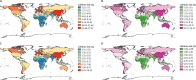
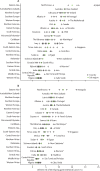
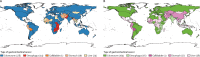
Findings: The global lifetime risks of developing and dying from gastrointestinal cancers from birth to death was 8·20% (95% CI 8·18-8·21) and 6·17% (6·16-6·18) in 2020. For men, the risk of developing gastrointestinal cancers was 9·53% (95% CI 9·51-9·55) and of dying from them 7·23% (7·22-7·25); for women, the risk of developing gastrointestinal cancers was 6·84% (6·82-6·85) and of dying from them 5·09% (5·08-5·10). Colorectal cancer presented the highest risk, accounting for 38·5% of the total lifetime risk of developing, and 28·2% of dying from, gastrointestinal cancers, followed by cancers of the stomach, liver, oesophagus, pancreas, and gallbladder. Eastern Asia has the highest lifetime risks for cancers of the stomach, liver, oesophagus, and gallbladder, Australia and New Zealand for colorectal cancer, and Western Europe for pancreatic cancer. The lifetime risk of gastrointestinal cancers increased consistently with increasing level of HDI; however, high HDI countries (the third HDI quartile) had the highest death risk.
Interpretation: The global lifetime risk of gastrointestinal cancers translates to one in 12 people developing, and one in 16 people dying from, gastrointestinal cancers. The identified high risk and observed disparities across countries warrants context-specific targeted gastrointestinal cancer control and health systems planning.
Funding: Beijing Nova Program, CAMS Innovation Fund for Medical Sciences, and Talent Incentive Program of Cancer Hospital, CAMS (Hope Star).
Copyright © 2024 The Author(s). Published by Elsevier Ltd. This is an Open Access article under the CC BY-NC-ND 4.0 license. Published by Elsevier Ltd.. All rights reserved.
Conflict of interest statement
Declaration of interests We declare no competing interests.
Figures

Similar articles
-
Global cancer transitions according to the Human Development Index (2008-2030): a population-based study.Lancet Oncol. 2012 Aug;13(8):790-801. doi: 10.1016/S1470-2045(12)70211-5. Epub 2012 Jun 1.PMID: 22658655
-
Human development index is associated with mortality-to-incidence ratios of gastrointestinal cancers.World J Gastroenterol. 2013 Aug 28;19(32):5261-70. doi: 10.3748/wjg.v19.i32.5261.PMID: 23983428 Free PMC article.
-
Global Burden of 5 Major Types of Gastrointestinal Cancer.Gastroenterology. 2020 Jul;159(1):335-349.e15. doi: 10.1053/j.gastro.2020.02.068. Epub 2020 Apr 2.PMID: 32247694 Free PMC article.
-
Cancer in sub-Saharan Africa in 2020: a review of current estimates of the national burden, data gaps, and future needs.Lancet Oncol. 2022 Jun;23(6):719-728. doi: 10.1016/S1470-2045(22)00270-4. Epub 2022 May 9.PMID: 35550275 Review.
-
Epidemiology of gastrointestinal and liver tumors.Eur Rev Med Pharmacol Sci. 2010 Apr;14(4):249-58.PMID: 20496531 Review.
Cited by
-
High expression of ABL2 promotes gastric cancer cells migration, invasion and proliferation via the TGF-β and YAP signaling pathways.J Cancer. 2024 Sep 9;15(17):5719-5728. doi: 10.7150/jca.99307. eCollection 2024.PMID: 39308677 Free PMC article.
-
Association of dietary inflammatory index and dietary oxidative balance score with gastrointestinal cancers in NHANES 2005-2018.BMC Public Health. 2024 Oct 9;24(1):2760. doi: 10.1186/s12889-024-20268-4.PMID: 39385181 Free PMC article.
-
The Role of Long Non-Coding RNF144A-AS1 in Cancer Progression.Cell Biochem Biophys. 2024 Sep;82(3):2007-2017. doi: 10.1007/s12013-024-01411-9. Epub 2024 Jul 16.PMID: 39014185 Review.
-
Immunotherapy of gastric cancer: Present status and future perspectives.World J Gastroenterol. 2024 Feb 28;30(8):779-793. doi: 10.3748/wjg.v30.i8.779.PMID: 38516237 Free PMC article.
-
Garcinol in gastrointestinal cancer prevention: recent advances and future prospects.J Cancer Res Clin Oncol. 2024 Jul 27;150(7):370. doi: 10.1007/s00432-024-05880-6.PMID: 39066940 Free PMC article. Review.
References
- Ahmad AS, Ormiston-Smith N, Sasieni PD. Trends in the lifetime risk of developing cancer in Great Britain: comparison of risk for those born from 1930 to 1960. Br J Cancer. 2015;112:943–947. – PMC – PubMed
- Sasieni PD, Shelton J, Ormiston-Smith N, Thomson CS, Silcocks PB. What is the lifetime risk of developing cancer?: the effect of adjusting for multiple primaries. Br J Cancer. 2011;105:460–465. – PMC – PubMed
- Arnold M, Abnet CC, Neale RE, et al. Global burden of 5 major types of gastrointestinal cancer. Gastroenterology. 2020;159:335–349. – PMC – PubMed
- Sung H, Ferlay J, Siegel RL, et al. Global cancer statistics 2020: GLOBOCAN estimates of incidence and mortality worldwide for 36 cancers in 185 countries. CA Cancer J Clin. 2021;71:209–249. – PubMed
- Ferlay J, Ervik M, Lam F, et al. Global Cancer Observatory: cancer today. 2020. https://gco.iarc.fr/today

