



Deependra Singh 1, Jerome Vignat 2, Valentina Lorenzoni 3, Marzieh Eslahi 2, Ophira Ginsburg 4, Beatrice Lauby-Secretan 5, Marc Arbyn 6, Partha Basu 7, Freddie Bray 2, Salvatore Vaccarella 2
Affiliations Expand
PMID: 36528031 PMCID: PMC9848409 DOI: 10.1016/S2214-109X(22)00501-0
Abstract
Background: Tracking progress and providing timely evidence is a fundamental step forward for countries to remain aligned with the targets set by WHO to eliminate cervical cancer as a public health problem (ie, to reduce the incidence of the disease below a threshold of 4 cases per 100 000 women-years). We aimed to assess the extent of global inequalities in cervical cancer incidence and mortality, based on The Global Cancer Observatory (GLOBOCAN) 2020 estimates, including geographical and socioeconomic development, and temporal aspects.
Methods: For this analysis, we used the GLOBOCAN 2020 database to estimate the age-specific and age-standardised incidence and mortality rates of cervical cancer per 100 000 women-years for 185 countries or territories aggregated across the 20 UN-defined world regions, and by four-tier levels of the Human Development Index (HDI). Time trends (1988-2017) in incidence were extracted from the Cancer Incidence in Five Continents (CI5) plus database. Mortality estimates were obtained using the most recent national vital registration data from WHO.
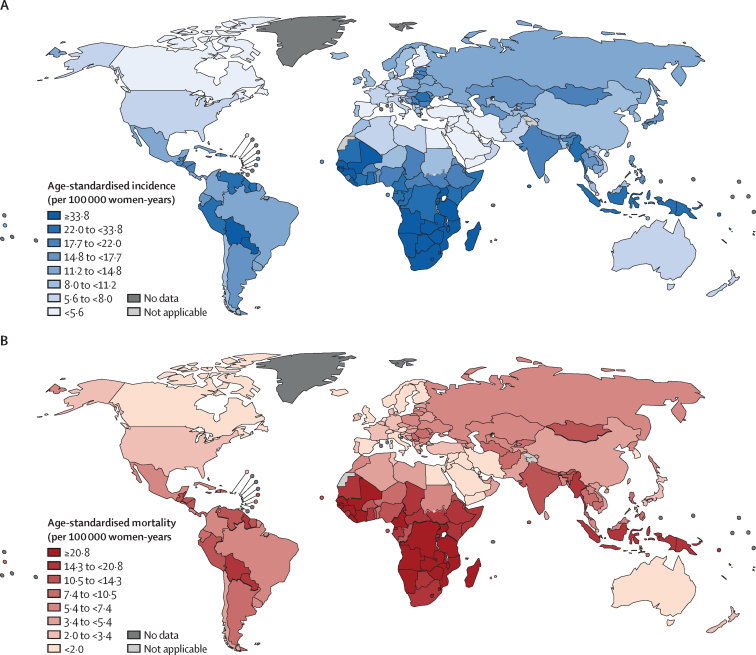
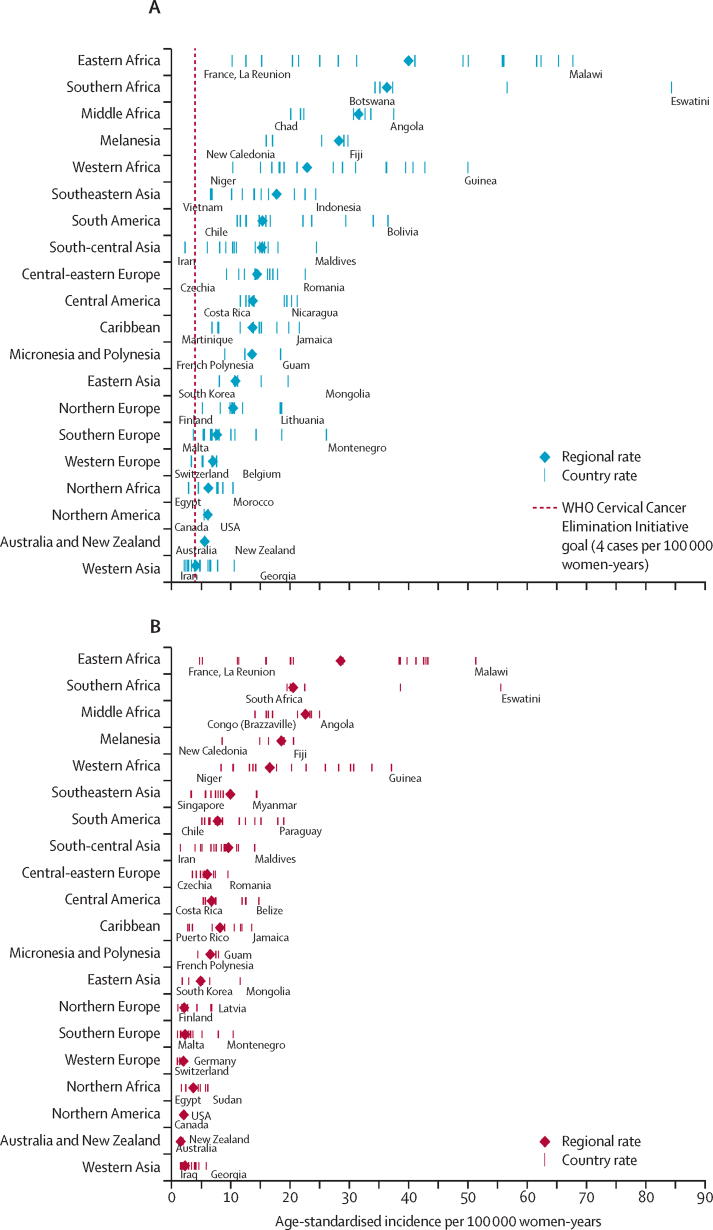
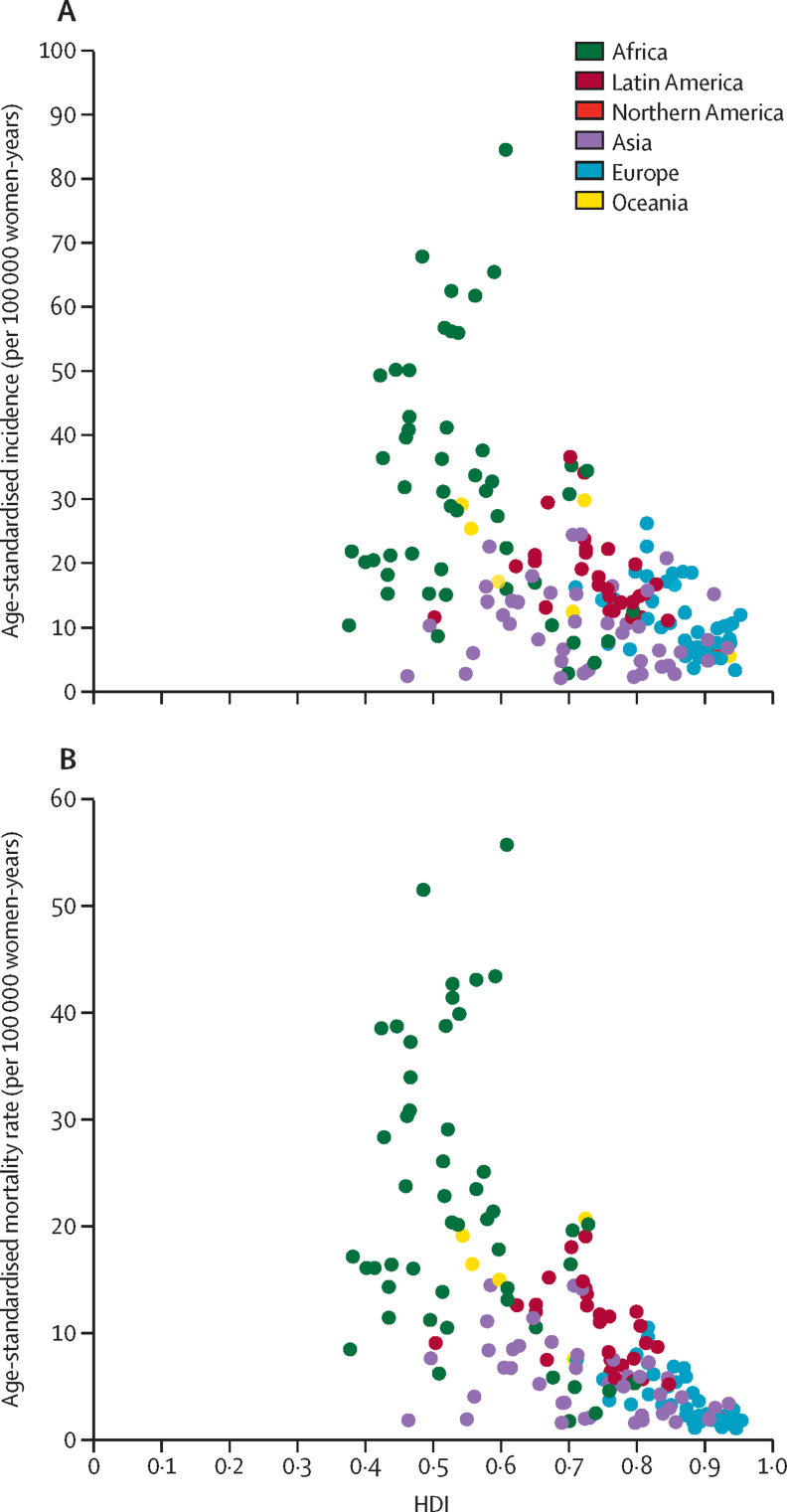
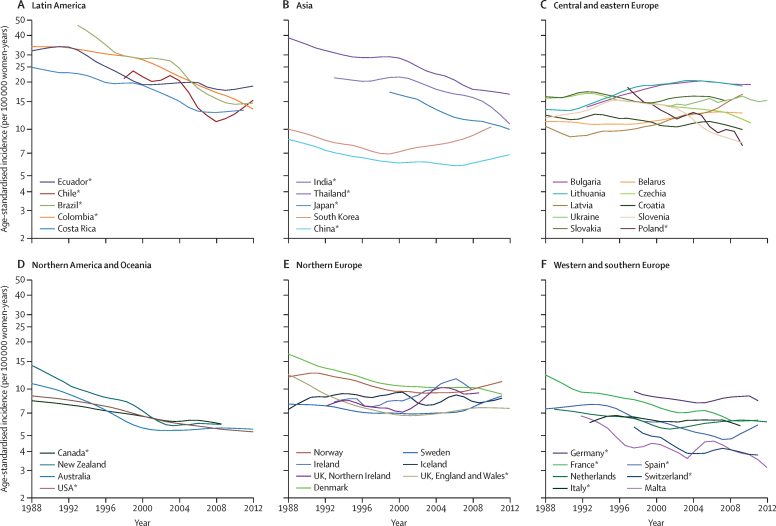
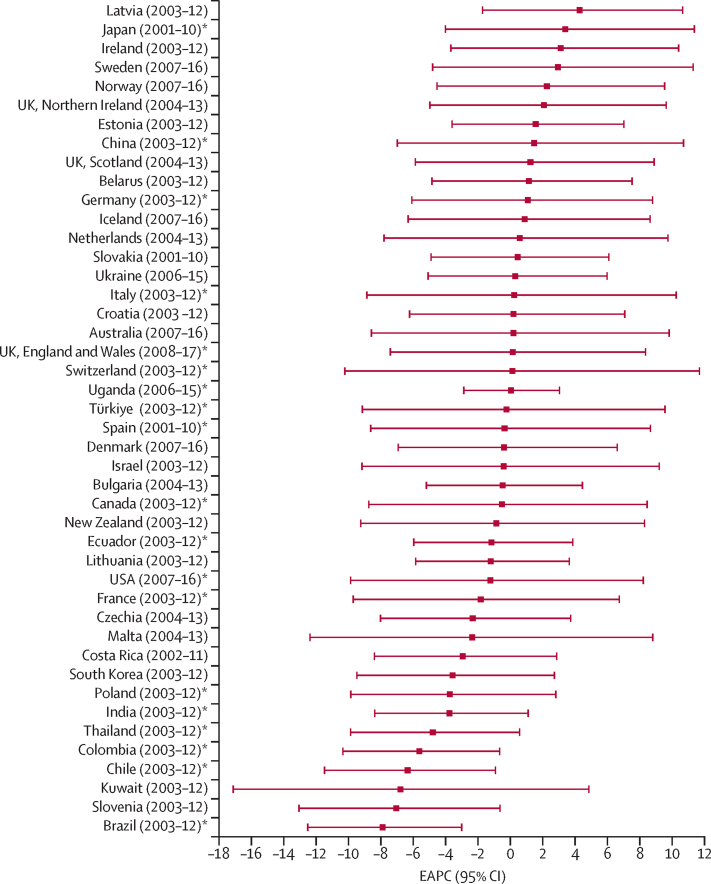
Findings: Globally in 2020, there were an estimated 604 127 cervical cancer cases and 341 831 deaths, with a corresponding age-standardised incidence of 13·3 cases per 100 000 women-years (95% CI 13·3-13·3) and mortality rate of 7·2 deaths per 100 000 women-years (95% CI 7·2-7·3). Cervical cancer incidence ranged from 2·2 (1·9-2·4) in Iraq to 84·6 (74·8-94·3) in Eswatini. Mortality rates ranged from 1·0 (0·8-1·2) in Switzerland to 55·7 (47·7-63·7) in Eswatini. Age-standardised incidence was highest in Malawi (67·9 [95% CI 65·7 -70·1]) and Zambia (65·5 [63·0-67·9]) in Africa, Bolivia (36·6 [35·0-38·2]) and Paraguay (34·1 [32·1-36·1]) in Latin America, Maldives (24·5 [17·0-32·0]) and Indonesia (24·4 [24·2-24·7]) in Asia, and Fiji (29·8 [24·7-35·0]) and Papua New Guinea (29·2 [27·3-31·0]) in Melanesia. A clear socioeconomic gradient exists in cervical cancer, with decreasing rates as HDI increased. Incidence was three times higher in countries with low HDI than countries with very high HDI, whereas mortality rates were six times higher in low HDI countries versus very high HDI countries. In 2020 estimates, a general decline in incidence was observed in most countries of the world with representative trend data, with incidence becoming stable at relatively low levels around 2005 in several high-income countries. By contrast, in the same period incidence increased in some countries in eastern Africa and eastern Europe. We observed different patterns of age-specific incidence between countries with well developed population-based screening and treatment services (eg, Sweden, Australia, and the UK) and countries with insufficient and opportunistic services (eg, Colombia, India, and Uganda).
Interpretation: The burden of cervical cancer remains high in many parts of the world, and in most countries, the incidence and mortality of the disease remain much higher than the threshold set by the WHO initiative on cervical cancer elimination. We identified substantial geographical and socioeconomic inequalities in cervical cancer globally, with a clear gradient of increasing rates for countries with lower levels of human development. Our study provides timely evidence and impetus for future strategies that prioritise and accelerate progress towards the WHO elimination targets and, in so doing, address the marked variations in the global cervical cancer landscape today.
Funding: French Institut National du Cancer, Horizon 2020 Framework Programme for Research and Innovation of the European Commission; and EU4Health Programme.
© 2023 World Health Organization; licensee Elsevier. This is an Open Access article published under the CC BY NC ND 3.0 IGO license which permits users to download and share the article for non-commercial purposes, so long as the article is reproduced in the whole without changes, and provided the original source is properly cited. This article shall not be used or reproduced in association with the promotion of commercial products, services or any entity. There should be no suggestion that WHO endorses any specific organisation, products or services. The use of the WHO logo is not permitted. This notice should be preserved along with the article’s original URL.
PubMed Disclaimer
Conflict of interest statement
Declaration of interests We declare no competing interests. Where authors are identified as personnel of the International Agency for Research on Cancer/WHO, the authors alone are responsible for the views expressed in this article, and they do not necessarily represent the decisions, policy, or views of the International Agency for Research on Cancer/WHO. Where authors are identified as personnel of US National Cancer Institute, the opinions expressed are their own and this material should not be interpreted as representing the official viewpoint of the US Department of Health and Human Services, the National Institutes of Health, or the National Cancer Institute.
Figures
Comment in
-
Cervical cancer elimination: actions needed in the COVID-19 era.Lancet Glob Health. 2023 Feb;11(2):e171-e172. doi: 10.1016/S2214-109X(22)00526-5. Epub 2022 Dec 14.PMID: 36528032 No abstract available.
-
Africa needs to boost HPV vaccine uptake to stem rise in cervical cancer.Lancet Oncol. 2023 Sep;24(9):955. doi: 10.1016/S1470-2045(23)00380-7. Epub 2023 Jul 27.PMID: 37517408 No abstract available.
Similar articles
-
Impact of scaled up human papillomavirus vaccination and cervical screening and the potential for global elimination of cervical cancer in 181 countries, 2020-99: a modelling study.Lancet Oncol. 2019 Mar;20(3):394-407. doi: 10.1016/S1470-2045(18)30836-2. Epub 2019 Feb 19.PMID: 30795950
-
Estimates of incidence and mortality of cervical cancer in 2018: a worldwide analysis.Lancet Glob Health. 2020 Feb;8(2):e191-e203. doi: 10.1016/S2214-109X(19)30482-6. Epub 2019 Dec 4.PMID: 31812369 Free PMC article.
-
The 2023 Latin America report of the Lancet Countdown on health and climate change: the imperative for health-centred climate-resilient development.Lancet Reg Health Am. 2024 Apr 23;33:100746. doi: 10.1016/j.lana.2024.100746. eCollection 2024 May.PMID: 38800647 Free PMC article. Review.
-
Folic acid supplementation and malaria susceptibility and severity among people taking antifolate antimalarial drugs in endemic areas.Cochrane Database Syst Rev. 2022 Feb 1;2(2022):CD014217. doi: 10.1002/14651858.CD014217.PMID: 36321557 Free PMC article.
-
Tuberculosis.In: Holmes KK, Bertozzi S, Bloom BR, Jha P, editors. Major Infectious Diseases. 3rd edition. Washington (DC): The International Bank for Reconstruction and Development / The World Bank; 2017 Nov 3. Chapter 11.PMID: 30212088 Free Books & Documents. Review.
Cited by
-
Awareness of HPV and HPV vaccine among college students in China.Front Public Health. 2024 Sep 18;12:1451320. doi: 10.3389/fpubh.2024.1451320. eCollection 2024.PMID: 39360252 Free PMC article.
-
Early evaluation of a screen-and-treat strategy using high-risk HPV testing for Uganda: Implications for screening coverage and treatment.J Glob Health. 2024 Sep 20;14:04157. doi: 10.7189/jogh.14.04157.PMID: 39302149 Free PMC article.
-
Predicting the status of lymphovascular space invasion using quantitative parameters from synthetic MRI in cervical squamous cell carcinoma without lymphatic metastasis.Front Oncol. 2024 Feb 6;14:1304793. doi: 10.3389/fonc.2024.1304793. eCollection 2024.PMID: 38380361 Free PMC article.
-
Public health concern-driven insights and response of low- and middle-income nations to the World health Organization call for cervical cancer risk eradication.Gynecol Oncol Rep. 2024 Jul 14;54:101460. doi: 10.1016/j.gore.2024.101460. eCollection 2024 Aug.PMID: 39114805 Free PMC article.
-
Controversies and Advances in the Personalized Surgical Treatment of Cervical Cancer.J Pers Med. 2024 Jun 6;14(6):606. doi: 10.3390/jpm14060606.PMID: 38929827 Free PMC article. Review.
References
- Arbyn M, Xu L. Efficacy and safety of prophylactic HPV vaccines. A Cochrane review of randomized trials. Expert Rev Vaccines. 2018;17:1085–1091. – PubMed
- Bouvard V, Wentzensen N, Mackie A, et al. The IARC perspective on cervical cancer screening. N Engl J Med. 2021;385:1908–1918. – PubMed
- Ginsburg O, Bray F, Coleman MP, et al. The global burden of women’s cancers: a grand challenge in global health. Lancet. 2017;389:847–860. – PMC – PubMed
- Arbyn M, Weiderpass E, Bruni L, et al. Estimates of incidence and mortality of cervical cancer in 2018: a worldwide analysis. Lancet Glob Health. 2020;8:e191–e203. – PMC – PubMed
- Yang M, Du J, Lu H, Xiang F, Mei H, Xiao H. Global trends and age-specific incidence and mortality of cervical cancer from 1990 to 2019: an international comparative study based on the Global Burden of Disease. BMJ Open. 2022;12 – PMC – PubMed

