




Oskar Bergengren 1, Kelly R Pekala 2, Konstantina Matsoukas 3, Jonathan Fainberg 2, Sean F Mungovan 4, Ola Bratt 5, Freddie Bray 6, Otis Brawley 7, Amy N Luckenbaugh 8, Lorelei Mucci 9, Todd M Morgan 10, Sigrid V Carlsson 11
Affiliations Expand
PMID: 37202314 PMCID: PMC10851915 DOI: 10.1016/j.eururo.2023.04.021
Abstract
Context: Prostate cancer (PCa) is one of the most common cancers worldwide. Understanding the epidemiology and risk factors of the disease is paramount to improve primary and secondary prevention strategies.
Objective: To systematically review and summarize the current evidence on the descriptive epidemiology, large screening studies, diagnostic techniques, and risk factors of PCa.
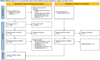
Evidence acquisition: PCa incidence and mortality rates for 2020 were obtained from the GLOBOCAN database of the International Agency for Research on Cancer. A systematic search was performed in July 2022 using PubMed/MEDLINE and EMBASE biomedical databases. The review was conducted in accordance with the Preferred Reporting Items for Systematic Reviews and Meta-analyses guidelines and was registered in PROSPERO (CRD42022359728).
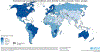
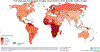
Evidence synthesis: Globally, PCa is the second most common cancer, with the highest incidence in North and South America, Europe, Australia, and the Caribbean. Risk factors include age, family history, and genetic predisposition. Additional factors may include smoking, diet, physical activity, specific medications, and occupational factors. As PCa screening has become more accepted, newer approaches such as magnetic resonance imaging (MRI) and biomarkers have been implemented to identify patients who are likely to harbor significant tumors. Limitations of this review include the evidence being derived from meta-analyses of mostly retrospective studies.
Conclusions: PCa remains the second most common cancer among men worldwide. PCa screening is gaining acceptance and will likely reduce PCa mortality at the cost of overdiagnosis and overtreatment. Increasing use of MRI and biomarkers for the detection of PCa may mitigate some of the negative consequences of screening.
Patient summary: Prostate cancer (PCa) remains the second most common cancer among men, and screening for PCa is likely to increase in the future. Improved diagnostic techniques can help reduce the number of men who need to be diagnosed and treated to save one life. Avoidable risk factors for PCa may include factors such as smoking, diet, physical activity, specific medications, and certain occupations.
Keywords: Epidemiology; Prostate cancer; Risk factors; Screening.
Copyright © 2023. Published by Elsevier B.V.
PubMed Disclaimer
Conflict of interest statement
Financial disclosures: Oskar Bergengren certifies that all conflicts of interest, including specific financial interests and relationships and affiliations relevant to the subject matter or materials discussed in the manuscript (eg, employment/affiliation, grants or funding, consultancies, honoraria, stock ownership or options, expert testimony, royalties, or patents filed, received, or pending), are the following: None.
Figures
Similar articles
-
Overdiagnosis and overtreatment of prostate cancer.
Eur Urol. 2014 Jun;65(6):1046-55. doi: 10.1016/j.eururo.2013.12.062. Epub 2014 Jan 9.PMID: 24439788 Free PMC article. Review. -
Epidemiology and Prevention of Prostate Cancer.
Eur Urol Oncol. 2021 Dec;4(6):877-892. doi: 10.1016/j.euo.2021.09.006. Epub 2021 Oct 26.PMID: 34716119 Review. -
Latest Evidence on the Impact of Smoking, Sports, and Sexual Activity as Modifiable Lifestyle Risk Factors for Prostate Cancer Incidence, Recurrence, and Progression: A Systematic Review of the Literature by the European Association of Urology Section of Oncological Urology (ESOU).
Eur Urol Focus. 2019 Sep;5(5):756-787. doi: 10.1016/j.euf.2018.02.007. Epub 2018 Mar 23.PMID: 29576530 -
Folic acid supplementation and malaria susceptibility and severity among people taking antifolate antimalarial drugs in endemic areas.
Cochrane Database Syst Rev. 2022 Feb 1;2(2022):CD014217. doi: 10.1002/14651858.CD014217.PMID: 36321557 Free PMC article. -
EAU-ESTRO-SIOG Guidelines on Prostate Cancer. Part 1: Screening, Diagnosis, and Local Treatment with Curative Intent.
Eur Urol. 2017 Apr;71(4):618-629. doi: 10.1016/j.eururo.2016.08.003. Epub 2016 Aug 25.PMID: 27568654
Cited by
-
[Incidence, therapy, and prognosis of prostate cancer in Baden-Württemberg: analysis based on cancer registry data].Urologie. 2024 Jul;63(7):681-692. doi: 10.1007/s00120-024-02275-w. Epub 2024 Feb 5.PMID: 38316650 Free PMC article. German.
-
Updated prevalence of latent prostate cancer in Chinese population and comparison of biopsy results: An autopsy-based study.
Innovation (Camb). 2024 Jan 2;5(1):100558. doi: 10.1016/j.xinn.2023.100558. eCollection 2024 Jan 8.PMID: 38261840 Free PMC article. -
Functional variants of the pentraxin 3 gene are associated with the metastasis and progression of prostate cancer.
J Cell Mol Med. 2024 Aug;28(16):e70041. doi: 10.1111/jcmm.70041.PMID: 39187920 Free PMC article. -
Phytotherapy Might Have a Role in Reducing Unnecessary Prostate Biopsies: Results from an Exploratory, Randomized Controlled Trial of Two Different Phytotherapeutic Agents.
Clin Pract. 2024 Jan 23;14(1):188-197. doi: 10.3390/clinpract14010016.PMID: 38391402 Free PMC article. -
Analyzing the mutational landscape of prostate cancer susceptibility genes through next-generation sequencing (NGS).
Am J Transl Res. 2024 Sep 15;16(9):4450-4465. doi: 10.62347/QRIF7244. eCollection 2024.PMID: 39398597 Free PMC article.
References
- Sung H, Ferlay J, Siegel RL, et al. Global cancer statistics 2020: GLOBOCAN estimates of incidence and mortality worldwide for 36 cancers in 185 countries. CA Cancer J Clin 2021;71:209–49. – PubMed
- Culp MB, Soerjomataram I, Efstathiou JA, Bray F, Jemal A. Recent global patterns in prostate cancer incidence and mortality rates. Eur Urol 2020;77:38–52. – PubMed
- Gandaglia G, Leni R, Bray F, et al. Epidemiology and prevention of prostate cancer. Eur Urol Oncol 2021;4:877–92. – PubMed
- Ferlay J, Colombet M, Soerjomataram I, et al. Cancer statistics for the year 2020: an overview. Int J Cancer 2021;149:778–89. – PubMed
- Ferlay J, Laversanne M, Lam F, et al. Global cancer observatory: cancer today. Lyon, France: International Agency for Research on Cancer; 2020. https://gco.iarc.fr/today

